After two decades, grant-funded program continues helping workers, students, laypeople cultivate skills
Kilgore College’s Risk Management Institute is not confined to any one classroom or lab, nor is there any single focus for workforce training.

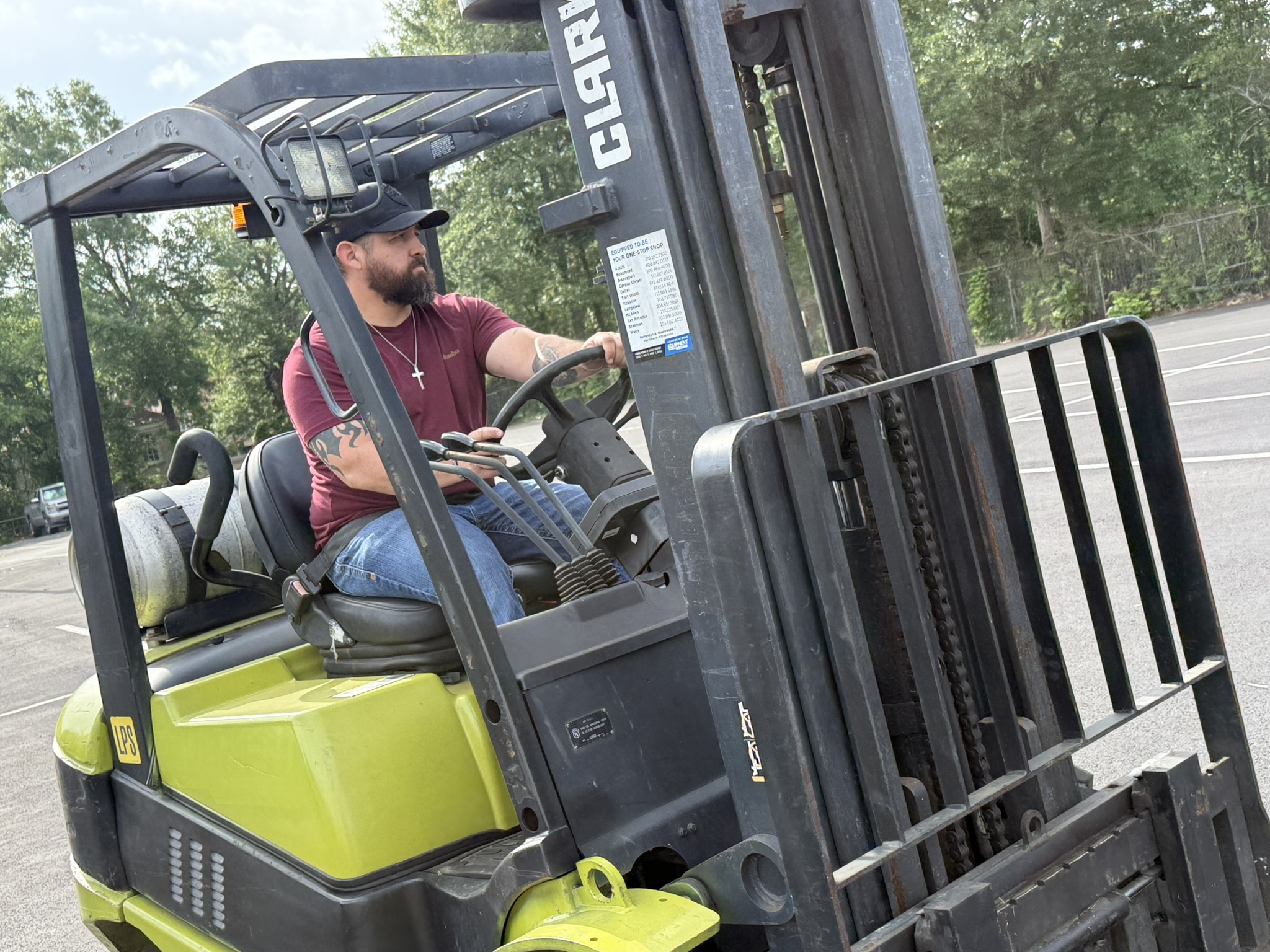
The 20-year-old program reaches from industrial floors to church groups, from high school students preparing for graduation to on-the-ground employees adding certifications to enhance their skillset. Forklift training, OSHA courses, leadership, management, soft skills and more help the current workforce while individuals and social groups rely on key skills like CPR and other courses to make their community better.
RMI’s offerings are built on years of experience and customized for the needs of employers and organizations throughout the city and area. It’s rooted in a robust public-private partnership between KC and Texas Mutual Insurance Company, funding $100,000 annually for 19 years, monies that have been used to enhance the skills of more than 20,000 participants.
“The grand purpose behind this grant and the RMI is all the safety training we do ultimately provides for a safer community around us,” according to Brandon Belken, Kilgore College Dean of Instructional Technology. “It really is a good grant and goes toward a good purpose.”
The Risk Management Institute has helped Kilgore College deliver free or low-cost continuing education courses for just shy of two decades. It’s covering essential training opportunities in Kilgore and East Texas, a major focus for Kilgore Economic Development Corporation and its local stakeholder companies.
For Kilgore College Workforce Development Liaison Rob Horn, the institute is one more way the college and Texas Mutual are actively serving the people and employers in a shared service area.
“It’s using the college to give back to the community.”

RMI courses are continuing education offerings for some, new skill development for others. Courses are tailored for current workers, nontraditional students and others who need practical certifications or specific skills within or beyond a traditional degree pathway.
That can mean a company sending workers for training. It can mean someone walking in from the community to add a credential to a resume. It can mean a high school student earning a forklift certification before graduation or grandparents participating in CPR training for the sake of their families.
“We have people coming in off the streets,” Horn said, always eager to see community members taking part to refine their skills.
Meanwhile, local companies are able to best ensure their employees have the training needed to work safely, efficiently and competitively.
“We have a basic offering, but that doesn’t limit us to working with industries and helping them provide even more training,” Horn said. Flexibility is a key part of the program’s value. Alongside established offerings, Kilgore College can take requests and develop classes to meet specific needs: “We want to show the community that we’re here to do what we need to do. Let’s get out there and get it.”
The course list is broad, Belken adds, from forklift essentials to industrial hygiene, leadership and management skills and more. Available options are leveraged on community needs and ever-evolving.

“There is a comprehensive list of courses,” he said. “There’s a good course selection to choose from.”
And, thanks to Texas Mutual, in most cases the courses are free.
Kilgore College’s Martha Woodruff spearheaded the effort, built the foundation and ensured for the program’s longtime success.
She’s the one who started it, Horn said, the one who cultivated the relationship with Texas Mutual and landed the recurring funding 20 years back.
“She’s the one who got out there and got the grant and started it. She’s great at writing grants. That’s her forte.”
Now, nearly two decades later, the long-running program is approaching a major milestone, ready to notch $2 million in public contributions from Texas Mutual, thousands and thousands of students served.
For Belken, the impact of RMI can be seen in individual classes and employer partnerships, but its full reach is harder to measure. Classes may include just a handful of people; there may be up to 30 – it’s not about filling a specific lab, classroom or facility but utilizing KC’s resources to educate, one course, one skillset, one participant at a time.
“It definitely moves the needle in the community,” he said. “It’s hard to say just how far that ripple is going.”
While demand varies by season and class, some offerings have become cornerstones on the calendar for the Risk Management Institute.
For example, OSHA 30 is a class the college aims to offer quarterly. CPR’s even easier to work into a person’s schedule with courses set three to four times per month.
Demand is high.

“Over the past year, they did 104 total classes,” Belken said. “They served almost 1700 students.”
There was a 74 percent increase in CPR students the past year, part of a 252 percent increase in CPR classes overall. All those successful trainees are now out in the community, trained and ready to step-in at a moment’s notice.
In the meantime, “Classes in general increased by 22 percent,” Belken added. “Total student enrollment increased 141 percent over the past year.
“We’ve got really good enrollment.”
The data tells the story: Kilgore College reports quarterly and at the end of the year, Horn noted, measuring not just how many people have been served, but how many classes have been made and how many industry partners have been involved.
“I look at all of those different numbers,” he said. “I want to make sure the classes are being offered throughout the year.”
The result is a program that is both structured and responsive. RMI is built around recurring needs but crafted to adapt to requests from the business community and partners.
Everybody’s welcome – the Risk Management Institute serves the broadest demographic. From high school students and the current workforce to community members well past retirement, training’s available for all comers.
Horn’s pleased to see young people in class again and again, working to earn as many certificates as they can. He’s welcomed with supervisors of all ages, presented certifications to a growing number of women alongside their male colleagues for forklift training and similar skills. Church members are active class participants.
“It’s a good, mixed pool for the most part of who we see,” from nursing students to warehouse technicians to future C-suite employees. “It covers a very wide gamut.”
The institute also reaches throughout the region, from Kilgore to Longview, White Oak, Tyler, Henderson and outlying areas as part of the broader service area.
“It’s to be a community outreach,” Horn added, “and to provide for the people in our service area.”
The college’s partnerships help extend that reach, such as working with Innovative Healthcare Solutions to provide CPR training or, on the industrial side, partnering with companies such as Revolution, Smallwood Homes and many others to ensure employers see the coursework that will directly benefit their employees and their operations long-term.
“They come back and say, ‘What else can Kilgore College do for us?’”
To learn more about Kilgore College’s Risk Management Institute, visit www.kilgore.edu/RMI